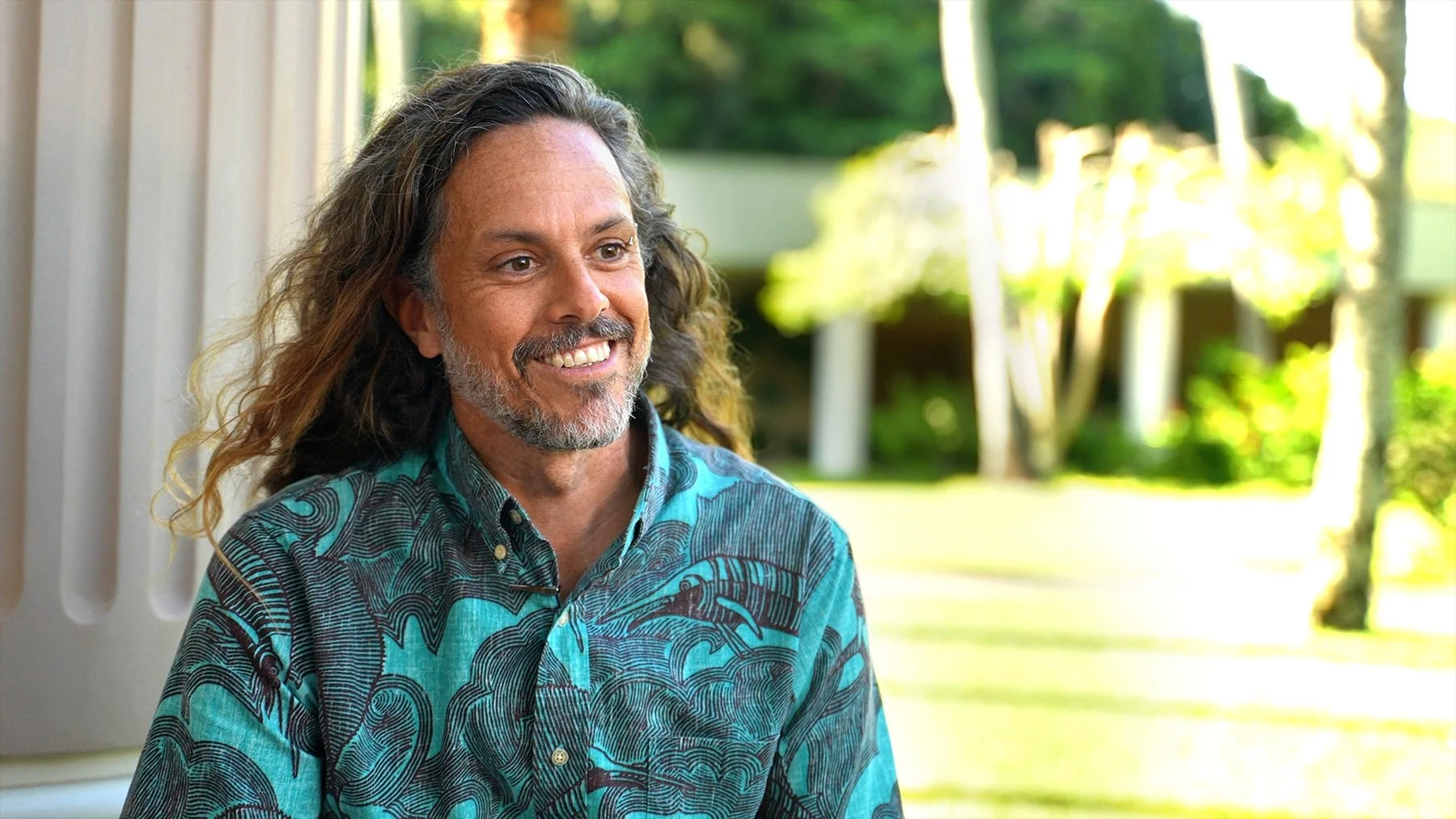
Jonathon Medeiros
Making Lei with BNM
Cut the grapefruit, two halves,
sugar
and then a yellow shirt,
and white shorts,
point at the horizon
and then head stand against the wall,
looking to the glass doors,
and then sit on a towel,
faded terry cloth, like buttered toast,
in the sun, on the shore,
at Kalihiwai, and then
hold the fat black cat, Willy,
heavy in your arms,
and then his hairless chin
and then also your hug
like a vice
and then “keep writing” and then also
“that’s enough, Bette Middler sings it
better” which you mean to mean
“I love you, but stop singing” and then
“I love you, too” and then
cut the grapefruit
in half
and notice that it is pink inside
and it is mottled yellow rind
and it is on the small white plate
and the spoon is impossibly small
like you but
not like a bird or any failed simile
and then
the toast, rye, buttered,
and then also
your ashes in a bag, in my arms,
my feet in the stream, Puʻukumu,
the water is clear, cold
like ashes in a bag in my arms,
and then the ashes mixed with water
at my ankles
up side down
head stand
smile simile
horizon
yellow
sugar spoon and
grapefruit
buttered toast
terry cloth towel
glass walls
ashes and water
sugar spoon and
Willy the cat
and then this one too
as I tie the knot:
your voice calling us
up
from the valley
from our visit there,
for a visit
The Teacher and the Hill
The house in Kalihiwai sits on a hill. The north facing walls are huge triangles of glass, meeting at a peak of maybe 30 feet above the cold tile floors. These walls of glass jut out towards the edge of the hillside, towards the sea. This is the hull of a ship and from the deck outside the glass walls, we stand like passengers and look out to see where we are going, to see the horizon, the ocean meeting the sky; we look out over the rolling greens of the folded valleys and the tallest trees, the giant mangoes and palms, are just brushing the waves in the distance. And once, standing right here, Grandma said “Thatʻs where they filmed Throw Mama from the Train,” pointing her slender finger. “Yes, I love that movie.”
In the winter, the whales jump above the swell, out of the pacific blue into the sky blue sky. In winter, we can feel the waves pounding Secrets (“Kauapea,” my mind corrects me in the voice of my student). Grandma used to do headstands against the wall here, smiling as she watched the upside down scene, the whales jumping down into the sky below.
The yard to the left of the house is (was) a grapefruit orchard that June and Dale planted. Those trees are gone now. There is no yard to the right, just driveway and then a steep drop to Puʻukumu Stream, and down to The Valley. Just a bit farther to the right is Puʻukumu Falls. The stream and falls both named for the hill that the house is on: Puʻu Kumu.
We never used any of these names when June and Dale were alive, when we came up here for weekends, sleepovers, picnic visits, family gatherings. We just said, Grandmaʻs House, or The Valley, or The River.
But
the wai here is Puʻukumu. Hill. Teacher.
And on a day in November, 2024, just before Thanksgiving, another family gathering, I walk down the steep and curving road to The Valley floor, June and Dale’s heavy ashes in my arms, and I think about how this place is a teacher. Puanani Burgess reminds us that anything can be our teacher. We just need to ask, What will we learn today? What is the water that flows from this teacher telling us about today? Or about tomorrow?
On this day in November, with their ashes in my arms, I havenʻt been here for 12 years. My brother, sister, mom, aunty...20 years? More? We make the walk slowly down the hill, me and Erin and our two daughters, David with his wife Becky and their two sons, Sarah with her husband Jared and their two children; mom and Aunty Mary stay up top, beyond their days of walking the dirt road down the steep hillside.
As we walk down, we go back in time. I learned that in geology class. But as we walk down into the past, the future is running all around us, weaving in and out between our bodies, stomping the tall grasses and splashing in the cold clear water at the crossing. And we walk towards the falls, towards the pool where we and our cousins played, where now our children and their cousins might play.
“Heʻs clearing the hillside by hand.”
“Are those...?”
“Yes, terraces, maybe a collapsed irrigation structure. Old.”
“I never knew those were there.”
Whose family cleared that hillside and grew food? When was that? People have been in Kalihiwai for centuries, in this little folded valley, too.
I have zero memories of being at the falls with Grandma or Granddad, except now this one, their ashes in my arms. I feel like being in The Valley, at the stream, at the waterfall, is huge, is filled with dozens or hundreds of single days, but I really remember just being lost here and enjoying that lostness. And the memories seem that way. Big, many, but also all swirled into one.
I cut myself down there once, climbing through the overgrown jungle, and the tiny wound became infected, swollen to the size of a golf ball on my left thigh, the skin tight and hot and painful and then it burst as I pushed on it a few days later, greenish pus oozing forth in a not unpleasant rush. Puʻu also means pimple.
What did that teach me?
Clean your wounds. Swim in clear water.
The house is a ship on top of the hill, but on this trip back, we went down below.
And I thought about the stream and Grandma and how a grandmother is mostly water, just like the rest of us. Even before she has children, she is mostly salt water, like the rest of us.
A grandmother is skin and hair
and freckles maybe, teeth and smiles.
She is solid things, elastic things, ephemeral things,
a body wrapped in clothes usually,
a personality too.
And a grandmother is bones
wrapped in flesh,
like the rest of us,
but also she is always mostly water.
And she is a lot of ashes too, eventually,
once she is a great, once she is a was.
But she is more ashes than I have scraped up from a fire pit and I learned that if she is stored in a humid columbarium too long, she is concrete, nearly.
And when she is in the stream, she is water again, cool water moving past my ankles, my brother’s ankles, and my sister’s too.
I struggle with the nearly solid mass of ashes, of used to be my grandmother, until the bags inside the metal boxes are mostly empty. We watch as the water turns gray in swirls and eddies and tendrils of cold current.
And then we get up out of the stream, the ashed water flowing away to the edge of the valley and the edge of the island. We play, we remember, we imagine the future as we walk back up the hill to the house, the ship facing the sea.
Jonathon Medeiros grew up on the mokupuni of Kauaʻi. He frequently writes about education, equity, place, and the power of curiosity, which kills boredom. If you changed all of your mistakes and regrets, you’d erase yourself. Jonathon walks, paddles, surfs, and enjoys spending time with his brilliant wife and daughters. His poems and essays have been published in various journals, including Bamboo Ridge Press, Hawaii Pacific Review, English Journal, Mythic Picnic, and The Hopkins Review. His debut chapbook, Mostly Water, is out now with Bainbridge Island Press. Much of his writing is collected at jonathonmedeiros.com; visit him there or in the line up.