Christina N. Lee
White Hair
It’s Sunday morning after the flood, but the rain refuses to leave. The potholes on the asphalt are filled with brown water. And although my mother tries to maneuver around them, she drives into one. We all jolt as though the wheel has stepped into a mine.
“Omoh,” yells Halmeoni from the backseat.
My mother turns around. “You okay, Eomma? Sorry. There’s just so many around here.”
Warehouses with parking lots surrounded by metal gates line each side of the road. There are signs posted in front that read LOT FULL. When we reach the end of the road, my mother presses the brake and we sit for a moment, stuck. She looks around and spots a car rolling out of one of the closed lots. “Found one!”
“Yikes, it’s so far away from the main sanctuary,” I sigh. “Too far for Halmeoni, don’t you think? Maybe we should just go home.”
“We’re already here. Don’t try to get out of church now. I made sure we didn’t go to a Korean church just for you.”
I roll my eyes. “That’s because Korean churches are toxic.”
“That’s your point of view.”
Halmeoni throws her straw hat at the center console. “QUIET!” she yells.
I pick up her hat and put it back on her head. “Sorry, Halmeoni.”
We get out of the car. I open an umbrella over my mother as she helps Halmeoni out of the back seat. It takes us fifteen minutes to reach to the main chapel.
Inside, the first eight rows are already full. Volunteers in matching navy shirts move through the aisles, brushing shoulders with their hands as they guide lost newcomers to the empty seats. There is a group of people with shirts that have the words PRAYER TEAM in bold white across their chests standing in a circle at the bottom of the center stage, holding hands as their heads are bowed. We take our seats in the last row. Halmeoni sits between my mother and me.
As the projector screen descends from the ceiling, more people arrive. A mother and her two daughters sit in front of us, their damp coats trapping the scent of rainwater, wool, and lavender perfume.
Five people walk on stage, each one taking their place behind a mic stand. “Everybody stand up! Stand up if you can!” yells the lead singer. He raises his hands over his head and begins to clap.
My mother stands up and stares at me as if to say Get. Up. Now. I point to Halmeoni and mouth, “Gotta watch her, you know?”
She rolls her eyes and turns her attention to the singers.
Halmeoni is more excited for the opening gospel than anyone else. She laughs and claps to the rhythm of the song. Then she takes my hand, squeezes it, and places it on top of her head expectantly.
I run my fingers through the white strands and tuck them behind her ear.
***
When I was a child, Halmeoni had maybe a handful of white hairs. Sometimes, when she was sleeping, I would try to pluck them.
In the afternoons, she’d sprawl out on the living room floor right next to the lanai door and rest her head on a cylindrical green pillow embroidered with pink and yellow flowers. The pillow was stuffed with buckwheat. I could never understand why she liked that pillow so much. It was so hard that it made crunching sounds when she shifted the position of her head.
While she was sleeping, she kept her hands and knees close to her heart, her body becoming a shield for what was inside. But she left her head open. My fingers sifted through her permed locks until they found a rare strand of white. A treasure. Round and round I wound it around my index. Just as I was about to pull, Halmeoni woke up.
“Yah!” She grabbed my hand. “If you pluck one, a hundred more will grow in its place. Leave it.”
For fifteen years, Halmeoni permed her hair every month at her friend Hyun-sook’s house just down the road from church. They gossiped about all the people who wanted to overthrow the newest pastor for either embezzling tithe money or being a heretic. Sometimes both. Most pastors, especially the young pastors, didn’t last very long.
It has been years since Halmeoni saw Hyun-sook to get her hair permed. The last time my mother took her, she went into Hyun-sook’s bathroom and threw feces into the small garbage bin next to the toilet seat. She wasn’t allowed at the house after that.
Halmeoni’s once curly strands are straight now, cut with precision by my mother into a pixie.
Shortly after the incident, Halmeoni started experiencing intense head pain.
“Right here. It hurts right here,” she whimpered.
In a panic, my mother called Halmeoni’s primary care physician. Her physician stated that the pain may be the result of another mini stroke and urged her to get an MRI. With her head pain rendering her immobile, my mother and I carried her into her wheelchair and sped to the emergency room. When we arrived, there was chaos. A fight between two patients had broken out and cops littered the already-crowded waiting room. After we spent three hours massaging Halmeoni’s hands and shoulders, a nurse finally took us in.
The moment the blood pressure cuff around Halmeoni’s arm inflated, she yelped and accused the nurse of trying to kill her. The doctor, a young man in his early thirties, came in, took one look at Halmeoni’s tear-streaked red face, and frowned.
He turned to my mother. “Is it really worth doing the MRI if the dementia patient does not want it?” Without waiting for a response, he walked out of the room, slamming the sliding door behind him.
The nurse led us back to the waiting area where we sat for another hour. When she returned, she gave my mother Halmeoni’s discharge papers and a prescription of lidocaine patches. “This doctor,” she said with a disgusted tone, “he doesn’t deal with dementia patients. He says he wants us to do the dirty job.” She shook her head. “I’m so sorry.”
“The dirty job? The f—”
My mother placed a hand on my lap. “It’s not your fault,” she smiled. “Thank you for your honesty. We won’t ever come back.”
As soon as we got into the car, I let the tears fall. “Those doctors are horrible, Mom. I can’t believe it. How can they say such a thing?”
My mother sighed. “After a certain point, doctors think it’s useless to do any procedure. I went through this so many times already.”
“What are we supposed to do now?”
“What the nurse recommended. Give her Tylenol and lidocaine patches for the pain.”
“And if she doesn’t get better?”
My mother started the car. “I will call the social worker.”
“It’s so dehumanizing.”
“Dehumanizing?” She scoffed. “This is so human.”
Halmeoni’s head is now a snowy tundra. But I never did pluck that white strand of hair. I promised her I wouldn’t.
***
The praise team leaves the stage. All the lights grow dim except for just one. It follows the pastor as he walks to the podium. He raises his hands above his head and closes his eyes.
“Let us pray. Father God, we thank you for bringing us all here today…”
Like a secret, Halmeoni’s hand finds mine. She holds it and brings it down to her lap.
I wrap my fingers around her index finger, just like how I used to when I was in elementary school.
She lifts each of my fingers, studies it, and folds it back over her index. Lifts. Studies. Folds. Lifts. Studies. Folds. She is confirming with herself that we were once the same body; that I was the oocyte in the ovaries of the little fetus that used to swim in her womb.
She finishes her inspection and squeezes. “I am Cho Ja.” She speaks slowly, enunciating each syllable, so I never forget. “I’m Cho Ja.”
“I know,” I whisper.
***
The rain continues to rustle over the chapel roof, just like how it did the Sunday before Cho Ja left forty-six years ago. That morning, the crickets were chatty. Her youngest, Jihoon, had wrapped himself around her leg like a vine. Her other two children lay flat on the floor, the i-bul kicked off to the very corner of the room. She quietly peeled her son’s sticky limbs off of her and walked into the living room.
The humidity of the summer shower seeped itself into the old wood leaving in its wake the smell of pine and old chestnut. In the corner of the living room, five suitcases stood against the wall. One for each person in the family. She had made sure to pack everything that was essential, from her daughter’s favorite piano score book to her husband’s precious white Esquire dress shoes, the only pair he had.
Her husband didn’t make it to the bedroom last night. He was on the floor, his neck bent at an uncomfortable angle next to the leg of the low table. She leaned over him and waited for his chest to rise.
He gasped. When she looked down, his eyes were still closed, both his black eyebrows raised in surprise. For a few seconds, his face remained like that. Frozen in its state of shock. Then, he exhaled, his lips transforming into a sputtering motor of ethanol.
This is how her husband had always slept: his face in a perpetual state of shock, like he had witnessed his father being shot by a Northern soldier all over again. She picked up a green floor cushion and propped it underneath his head.
In the kitchen, she quietly filled three small cloth sacks with barley rice. She tied the bundles and put them in her satchel. Without waking her children, she left for her sister-in-law’s.
The light drizzle continued, covering her hair and arms with dewdrops. She lifted her long dress so that it wouldn’t get muddy and walked the path along the barley field. It didn’t take more than fifteen minutes to get to the next homestead.
In the yard, there was an i-bul hanging on a wire line. Cho Ja pulled it down and brought it to the front door.
“Myung-Ja yah,” she called softly. “Myung-Ja yah!”
There were soft knocks and rustles coming from somewhere far away. Then she heard the click of the door knob being turned.
When Myung-Ja opened the door, she was wearing the same dress as Cho Ja. Cho Ja chortled at the sight, tracing her slim figure with her free arm. “You really are my sister!”
But Myung-Ja wasn’t her usual self. Her face remained expressionless. Somber. She looked down at her i-bul tucked underneath Cho Ja’s arm. “Is it raining?”
“There was a little rain when I first got here, but it should be over now.”
Myung-Ja took the i-bul from Cho Ja’s arm and disappeared again into her house. When she returned, she chained her arm to Cho Ja’s. “Let’s go.”
They walked in silence all the way to church. Cho Ja knew that Myung-Ja was devastated about their move, but she didn’t say a word. She didn’t know how to comfort her best friend, who would be losing not only her, but also her favorite sibling.
When they got to the church, a handful of people were already moving up the steep steps to the main chapel. Cho Ja quickened her pace and Myung-Ja followed. At the foot of the stairs, Cho Ja bundled the fabric of her dress in both hands. Despite trying to be careful, her foot missed the first step and she fell, bringing Myung-Ja down with her.
They looked at each other, eyes wide with bewilderment. Then, Myung-Ja started laughing. She laughed so hard that tears streamed down her face. Cho Ja laughed too. Without thinking, she wiped Myung-Ja’s face with her mud-covered hands, smearing her cheeks with brown. Myung-Ja laughed even harder, slapping Cho Ja’s leg. And then she couldn’t hold it any longer. She wept.
“Yah!” Cho Ja yanked Myung-Ja into her arms and pounded her back with her fist. “Stop crying,” she scolded. “Stop crying. Ddook! Ddook!” But they were both crying.
After a minute of enduring Cho Ja’s “ddook-ddooks” and fists, Myung-Ja pulled away.
“We must look crazy,” she chuckled.
“Two small women covered in mud and crying at the foot of the church,” laughed Cho Ja. She looked around. Her satchel was an arm’s length away. She picked it up and opened it, making sure that none of the rice had spilled in their fall. Thankfully, the rice remained intact.
“Now, let’s go give this to the hungry pastors,” said Cho Ja.
***
After the final “amen,” people settle into their seats. My mother opens her Bible. The sound of the pages turning blends in with the rain outside and they become indistinguishable from one another.
The prayer team passes buckets around. People put checks, loose dollars, and envelopes into them. When it reaches Halmeoni, she digs into her pocket, finds a napkin, and drops it in the bucket. Then, she leans in and whispers something in my mother’s ear that I can’t hear.
My mother’s lips quiver before finding their way into a smile.
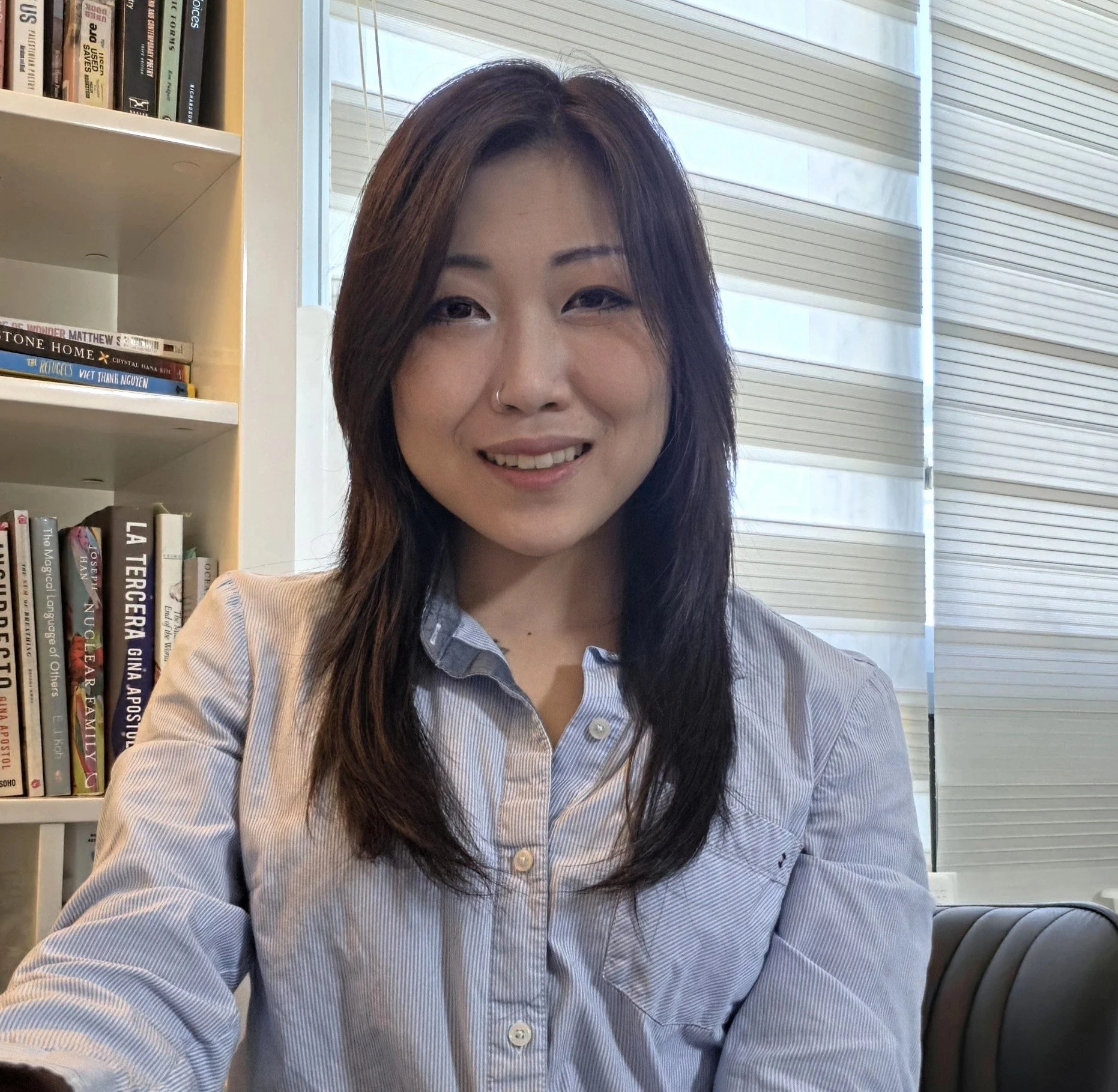
Christina N. Lee is a writer and educator born and raised on Oʻahu. She has published both short fiction and poetry in a special issue of Bamboo Ridge, Kīpuka: Finding Refuge in Times of Change. In 2023, “Kill Your Darlings,” her piece, a short autofiction that explores the traumatic effects of sexual violence, was awarded the Biography Prize by the University of Hawaiʻi at Mānoa's Center for Biographical Research.