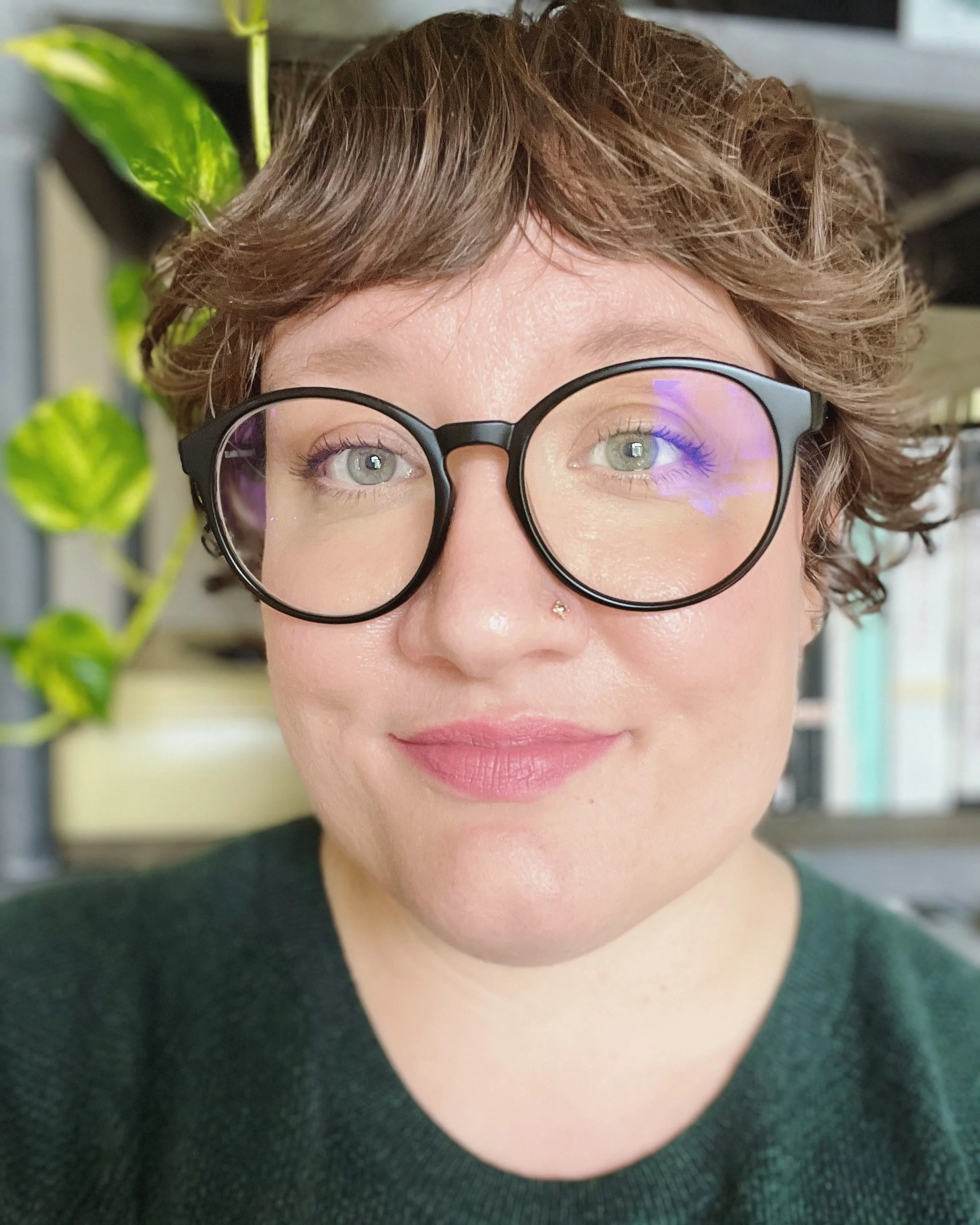
Brittany Winland
Crystal — West Virginia, 2037
Everyone knows I love beautiful things.
Beauty, of course, is entirely subjective—it’s all a matter of opinion. The dictionary beside my father’s desk says that something beautiful gives pleasure to the senses or the mind. Pleasure is tricky word itself, isn’t it? What makes me feel pleasure is not what makes someone else feel it, and neither pleasure or beauty relies much on logic. It’s a wonder, really, that people ever find anything universally beautiful—we cannot seem to agree on much of anything at all. These mountains are beautiful. If I say that, most people here would agree. Zoom in, they would even agree that this particular holler is beautiful, this individual oak growing beside the road, with its straight-standing trunk and its slender, curving branches crowned in lacy patterns of green. But get even closer and look at the carcass of the rabbit lying underneath—sad victim of a car passing by on the road.
My dad told me once, about rabbit hearts. We were driving along some back road, going home from somewhere I can’t remember now, and night was beginning to creep in along the edges of the day. The light turned blue-grey and shadows clumped together in the low, flat ground along the road. My dad switched his headlights on. And then, up from one of the ditches, a rabbit leaped onto the pavement and then startled, began to run from the terrible rolling of the car’s tires eating up the road between us. My dad tapped the brakes, but we were so close to the rabbit, so close I lost sight of it for a second. Then, it reappeared in front of us, ran for several more paces, and then dove off the road and into the darkened bank to the side again. I breathed deep, my heart pounding. Relieved.
My dad eased the car back to our former speed, and then he said, “You know it probably didn’t make it, right? The little ones usually don’t when they’re scared like that.”
I remember my confusion. “But I saw it,” I said. “It made it off the road.”
“It’s the adrenaline,” he told me. “Their little hearts can’t take all of that panic.”
This might have been the beginning of my dad trying to warn me. Of the reality checks, the grim lessons wrapped up as protection. Was I the rabbit, our car tires the rest of the world? And if I was the rabbit, what was I supposed to take from this lesson? Stay hidden, maybe—don’t go on the road at all.
Anyway, most people wouldn’t find beauty in this rabbit’s body now, torn and eaten away by other animals, by insects and by sun and rain. By time. The soft fur still there, still clinging to the frame, the bones now revealed in their delicate detail—the tiny little ribs, the intricate precision of foreleg and foot bones. But I do. The way the boundary between the rabbit’s body and the earth has become blurred—dirt breaching the perimeter, the grass starting to grow over along the edges of the rabbit’s back and along the limbs, the perfect little ears almost lost now to a creeping white fungus—all of this is beauty. And there, an energetic weed growing up right through the middle of the small body. I pull out my phone and take a picture. Beautiful.
The coven has different words for what I do. Opal has called me a collector. Ruth Ann once used the word obsessive, and Jess—when she caught me taking close-ups of a deer leg we found on one of our walks in the woods—macabre. But I think Mac has come the closest to understanding. She says I am a curator. I see something beautiful and I take a picture of it with my phone.
My parents call it my hobby, but it isn’t a hobby—it’s a way of living in this world. It’s a means of survival. Do I have a rabbit heart? So much of the world seems intent on catching me under its tires—the human world, anyway. Everything that is more than human is my ally. My kin in wildness. No wild thing ever seeks to be anything but itself, and neither do I.
Mac and I met in Kindergarten. She always wore boy clothes, even back then—Levis or overalls, plain colored t-shirts at least one size too big. I remember Joe Pickens went up to her one day while she was playing with the big foam blocks in our classroom. “Are you a boy?” he asked her. She looked up at him and asked back, “Are you an idiot?” After that, I worked up my nerve for a while and then went and sat down near her. She looked at me. That was the first time I got a good look at her eyes—they are so green, and glittering like an animal peering out at you from the woods.
“I’m a girl, too,” I told her. “My clothes are for boys, but I’m a girl.” Mac didn’t say anything for a minute. Just kept looking. Opal says that Mac has the gift of seeing things true. “Ok,” she said. And then: “help me build this wall to keep the boys out."
Later, after lunch, Joe Pickens made fun of me for lining up with the girls to go out to the playground for recess. “What’s wrong with you?” he said. “You’re a boy.” And there was Mac, leaning her wiry little body between us, a snake about to strike Joe Pickens, who had the foresight to look alarmed. “You are an idiot, I guess,” she said. And after that, no one bothered me about where I lined up again. It was like even the teacher was afraid of Mac.
Mac sees things true, and she’s not wrong, calling me a curator—just incomplete. If we lived in a different time, she would probably have the whole of it. But we live in this time, and it isn’t enough now just to notice beautiful things. This world is dying. So many things are passing away, beyond our sight and sound and touch. So I document, I preserve the image. My gallery of finite things. I keep the proof. The sunlight hit this dusty window in the school gym just so, right at that moment, and it painted golden squares of light against the varnished wood floor. This red cardinal called out with these particular notes as dawn broke, as the sky brightened and the mountains announced themselves as dark rounded outlines. See, I took a video. This insect (cicada), this tree (flowering dogwood), this yellow-crowned weed pushing up from a crack in the sidewalk (dandelion) were all here.
I am an elegist. I mourn the things which are passing away. I celebrate them, right now, in this sliver of space between worlds, this crack in time. These things were here. They existed, and they were beautiful.
I often come and stay with Opal. Sometimes my house feels like it is slowly choking me, squeezing thick fingers around my neck and crushing my windpipe. My parents, with their tight faces and pinched mouths of disapproval, their refusal to use my real name or see me as I am, slowly drown me. I flee, and Opal gathers me in. Drowning is just time lopped off, the reel cut too soon, she tells me. You go under the water, and you wait—you wait while your lungs burn and your mind sets itself on fire—and then you come back up out of the water, and you are reborn. You are the new thing you were always meant to be.
You’d think Opal’s parents wouldn’t want me around—them being so religious and me being me. But if they have ever protested, Opal has never let on, and they never ask me to leave, or say anything at all. Opal’s sisters—all five of them, from Di, a year older than Opal herself, down to little Saph, just four years old—flow around me, never giving me more than a slightly-long stare and always using my real name. I can’t really explain it—my own parents, while they go to church, aren’t fundamentalists like Opal’s family. They go to Sunday service in their Sunday clothes and sing sedate hymns and are seen there by all the other people in town who decide which people are good, and which are bad. Their religion is skin-deep, surface level. Opal’s family lives and breathes it, but they leave me be. They let me tuck myself into their fold. It is Sunday morning. Di is already up and dressed and has left the tiny little bedroom she shares with Opal. I have folded and put the quilt she leant me back on her bed. Opal and I push the thin mattress I sleep on back under her twin bed frame. The room is pale and tinged with blue dawn—like being under water. Opal’s next-youngest sister—Pearl—has outgrown her church dress. Pearl is a clumsy girl, and absentminded—I once watched her set a hot iron down into the sink full of soapy dishwater instead of back on the ironing board, and Opal had to grab it up quick and unplug it before she electrocuted herself. So the dress was torn in places and stained. Her parents let Opal have it instead of passing it down to the next girl like they normally do. Opal worked on it—she patched and washed, she embroidered the places she couldn’t get the stains out from, and she took in the waist and the bust. She added some gathers around the waist, to make it look fuller in the hips. She did all of this for me.
She buttons up the back of it for me now. The room is quiet and still, though beyond it the house is bubbling, everyone waking and bustling around, getting ready for church. I can smell the coffee brewing and hear Opal’s littlest sisters squabbling over a hair bow. But here, Opal and I are floating in our underwater world. I am holding my breath. I am letting it burn a little, while Opal stitches me together. Now she starts on my hair. She brushes it gently, from root to end, taking care when she hits a snarl, working it out with slow patience. When my hair feels smooth Opal divides it into three sections and she begins to braid them. I’ve been trying to grow it long for a while now, but my dull brown hair has only just reached down between my shoulder blades this summer. Partly because my parents kept making me cut it, and partly because it just grows slow. Like me. I always love Opal’s braids—she makes them so neat and tidy. I like to see the separate pieces of a braid woven together into something new. Opal chooses a rose-colored velvet ribbon from her little box of them on top of the dresser she shares with Di, and she ties it to the end of my braid.
There is a small, flat mirror—unframed and plain, purely utilitarian—leaned up against the wall on top of the wooden drawers. Opal brings it down and holds it up to me. And there I am. The image reflected back truer and wilder—the self I am and nothing in between. I touch a finger to my chest bone—do I have a rabbit heart? I can feel it fluttering, racing. The room is getting brighter, slow and steady. We are rising, me and Opal. She takes back the mirror and puts her hand in mine. She opens the bedroom door, and pulls me toward the threshold. Drowning doesn’t have to be the end. Not every rabbit is roadkill. I let Opal pull me up and break the surface. I breathe in deep—I feel cool and clean and strong. I am the new thing I was always meant to be. I slip my phone into the pocket of my new dress and join the other girls around the long table where they grab biscuits and bacon before we leave for service. I can’t wait to capture more beautiful things.
Opal in her long white church dress, when the singing starts—when she forgets everything else but the sound that’s caught her up in its current—and her face is pointed up toward the church house ceiling where the light gathers and her eyes are almost closed. My phone, low in my lap—only half out of my pocket, secret, secret because they aren’t allowed in service—the camera captures her just like that, the sun against her long throat and her braids falling down her back and she is beautiful, so beautiful. She is so perfect in this moment, and now this moment lasts forever, in a fashion, inside my phone museum. Opal in her ecstasy existed.
I exist. I existed. And I, too, was beautiful.
Originally from West Virginia, Britt Winland is an instructor in the English Department of the University of Hawaiʻi at Mānoa, where she teaches first-year composition and creative writing classes. Her work has appeared in Kestrel and An Ocean of Wonder: The Fantastic in the Pacific.